
ERRC stands for emergency responder radio coverage, and an ERRC system, sometimes written ERCES for emergency responder communication enhancement system, is the equipment that provides it: the amplification and antenna infrastructure that lets police and fire radios operate reliably inside a building. If you have encountered the term on a plan review, a permit, or a specification, this page explains what the system consists of and how the naming fits together.
What an ERRC system consists of
Whatever an authority or specification calls it, the system has the same anatomy:
- A donor antenna, typically mounted on the roof and aimed at the serving public safety radio site, which brings the outside signal in.
- A signal booster, the bi-directional amplifier, built and listed to life safety standards, with battery backup sized so the system keeps working when building power fails.
- A distributed antenna system, the cabling and interior antennas that deliver coverage into stairwells, elevators, basements, and the other critical areas the Code prioritizes. Our DAS explainer covers this layer in depth.
- Monitoring, through the system’s own alarms and, typically, a connection to the building’s fire alarm panel, so faults announce themselves instead of hiding until an emergency.
That anatomy is why the industry shorthand for these systems in Florida is simply BDA, after the amplifier at the center. Our What Is a BDA System page is the plain-English version of the same equipment.
Where the term comes from
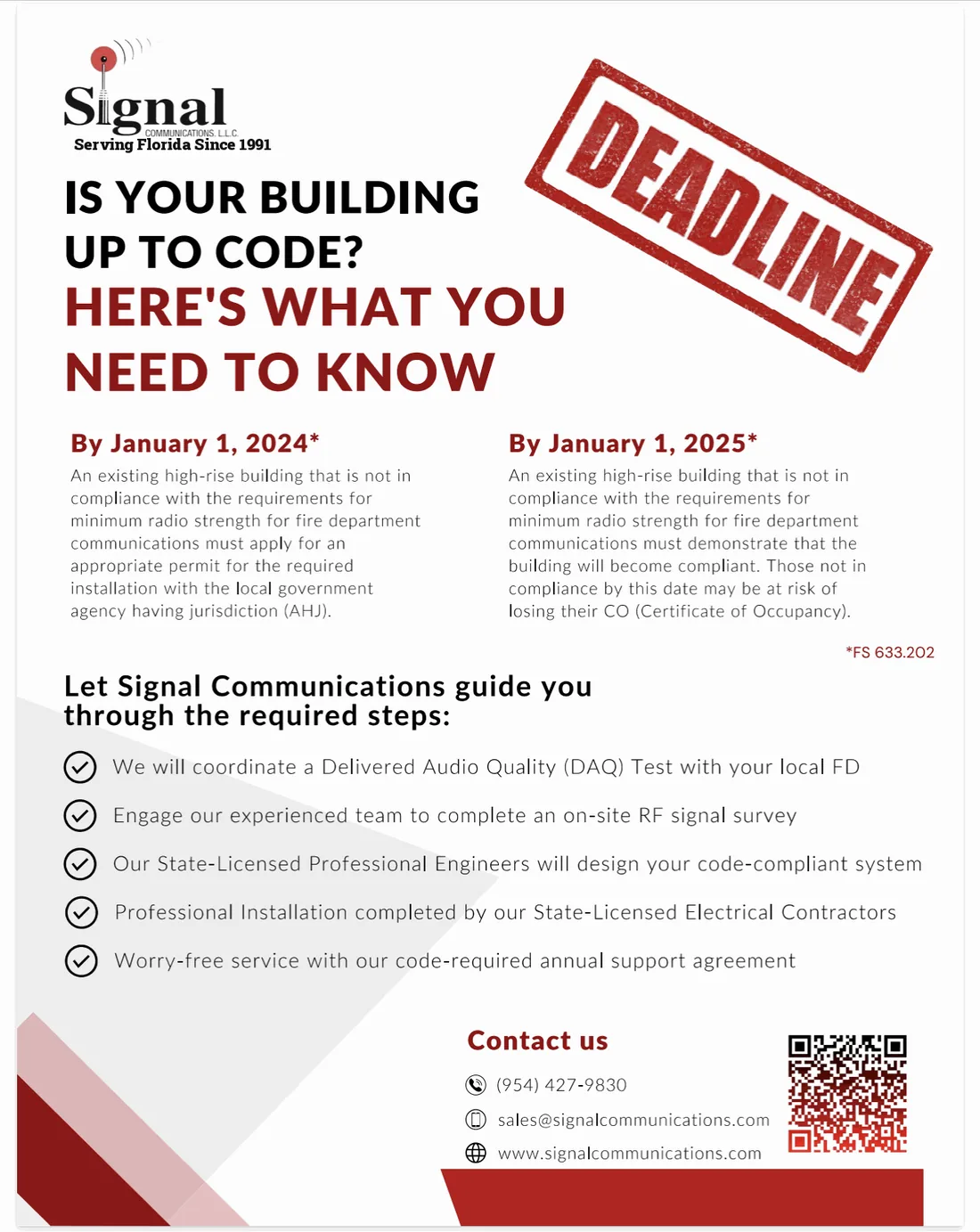
The NFPA standard behind this equipment, historically NFPA 1221 and today its successor NFPA 1225, uses the newer term communication enhancement system, which is why ERCES appears on newer specifications while older documents and most day-to-day conversation in Florida still say ERRC or BDA. The requirement behind all of it is emergency responder radio coverage under Florida Statute 633.202 and the fire Code, explained in full on our ERRCS in Florida page. Different decades of Code writing, one obligation.
What owning one involves
An ERRC system is a life safety system, and Florida treats it like one. Professional design with signed and sealed drawings, authority review, permits, and acceptance testing get it installed; most jurisdictions then require an annual service agreement, annual inspection, and recertification to keep it compliant. The full process is in the Florida Public Safety BDA Guide, the measurement is on BDA Testing in Florida, and the day something fails is covered in What Happens Next.
Frequently Asked Questions
No. They are different generations and styles of naming for the same category of equipment and requirement. Specifications trend toward ERCES, notices vary, and Florida’s industry shorthand is BDA.
No. It carries public safety radio frequencies. Cellular coverage is a separate, voluntary system; see our In-Building Cellular Amplification page.
ERRC systems are built to life safety standards, which include backup power, because the system must work precisely when the building loses power in an emergency.
Your Authority Having Jurisdiction (AHJ), typically the Fire Department or fire marshal, along with the local building department through the permitting process.