
If you own or manage a building in Florida, there is a good chance that at some point a fire official will ask you a question you have never heard before: can first responders’ radios communicate inside your building? This guide explains where that question comes from, what the law requires, how the process works from the first notice to final sign-off, and how to avoid the mistakes that cost building owners real money.
Start here: requirements vary by City and County
This is the single most important thing to understand about public safety BDA requirements in Florida, so it comes first.
The Code that governs these systems is written at the national level by the NFPA and other sources, and then typically adopted by the State of Florida, and then adopted and applied by individual Counties and Cities. The written requirements are broadly consistent. How they are interpreted and applied is not. The Authority Having Jurisdiction (AHJ), usually your local Fire Department or fire marshal, decides how testing is performed, which areas of your building must be covered, and what documentation is required. Two buildings five miles apart, in different municipalities, can face genuinely different requirements.
That is not a flaw in this guide. It is the reason this guide exists. Everything below describes how the requirements are written and how the process typically unfolds. For how it applies to your specific building, the answer always runs through your local authority, and a qualified integrator’s job is to know your jurisdiction and navigate it with you.
What is a public safety BDA, in one paragraph
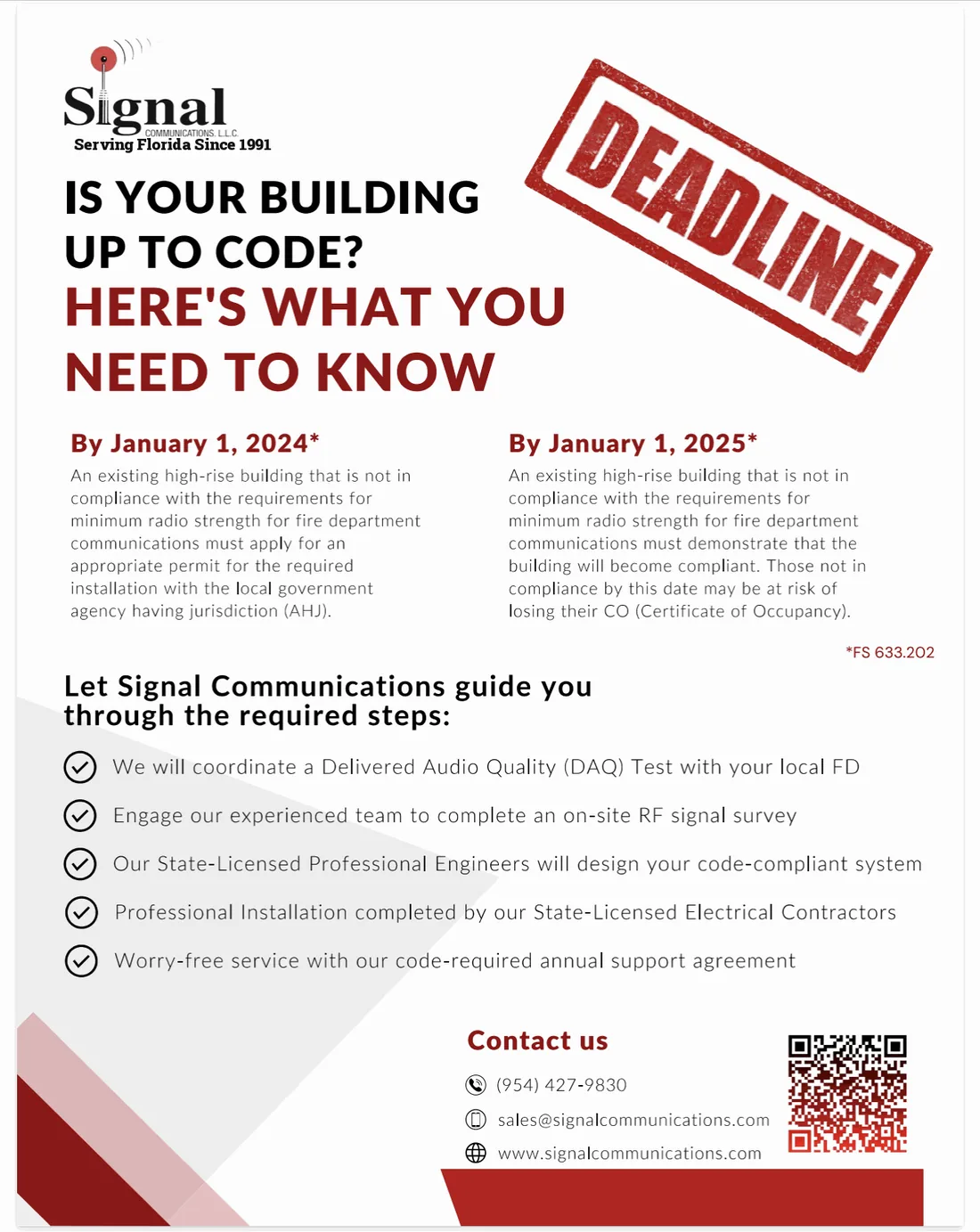
A bi-directional amplifier, or BDA, is a system that captures the public safety radio signal from outside a building, amplifies it, and distributes it through the building over a network of internal antennas, so that police and fire radios work everywhere inside: stairwells, elevators, basements, hallways. Florida Statute 633.202 requires buildings to meet minimum radio signal strength for Fire Department communications, and it puts the power to determine that minimum in the hands of your local authority. Compliance deadlines in the State of Florida have been established and have passed for certain existing buildings. See Signal’s Florida BDA deadline flyer for the key dates. The BDA is the system that provides the coverage where the natural signal falls short. For a full explanation, see What Is a BDA System.
Where the BDA requirement came from
The technology predates the Code. After September 11, 2001, when firefighters inside the New York Twin Towers could not receive the evacuation order over their radios, the need became a national priority, but Code development took many years. Parts of the NFPA Code had existed for decades, and some touched what became BDA requirements, but the material was disjointed and difficult to follow. The NFPA’s dedicated BDA public safety communications requirements took shape in the mid-2010s, and Florida Counties began adopting and enforcing them in the years that followed.
Florida was ahead of that curve for a hard-earned reason. In April 2015, improperly deployed public safety amplification systems in South Florida caused days of harmful interference across County 911 public safety radio networks, until the sources were tracked down, one of them from a helicopter, and shut off, with the FCC following up. Broward County, heavily affected by this harmful interference, produced some of the earliest formal guidelines for these systems in the State of Florida, guidelines that helped shape the Code Florida uses today. Signal Communications played an early and active role in assisting the County with these guidelines, as one of South Florida’s trusted public safety partners and an early BDA system integrator. The full story is on our Broward County page. That incident is also why these systems are so heavily permitted and regulated: a badly engineered and deployed BDA system is not just useless, it can also actively endanger the overall performance of the 911 system and the population it protects.
When is a BDA required... Or Not
A BDA is required when a building cannot meet the minimum public safety 911 radio coverage thresholds in the applicable Code as applied by your local authority, typically 90 percent general coverage and 99 percent in critical areas such as elevators, lobbies, stairwells, hallways, and paths of egress where occupants and first responders move through a building. If a building’s natural coverage passes testing as defined by the AHJ, no BDA system is required. Many buildings pass. Newer construction with energy-efficient glass and heavy concrete tends to fail more often, because the same materials that keep cooling costs down also block radio (and cellular) signals.
In practice, the requirement usually surfaces one of four ways:
- An annual fire inspection. The inspector checks radio coverage along with the fire alarm system, exits, fire extinguishers, etc., and flags the building by way of a Code violation report or warning.
- An actual emergency. First responders arrive, their radios fail inside, and the building receives a violation after the fact. It happens, and it is the worst way to find out.
- New construction or renovation. Public safety coverage testing is part of plan review, permitting, and the certificate of occupancy process.
- A proactive owner. A growing number of building owners and property managers test ahead of enforcement, because large systems can take a full budgeting cycle to fund and nobody wants to plan and complete an expensive BDA system under a deadline or mounting fines. Signal’s Florida BDA deadline flyer covers the deadline details.
One more driver worth understanding: Florida’s statute set phased compliance deadlines for existing high-rise buildings, and the final extension has passed, which is part of why these conversations are happening in more buildings every year.
If you have received an AHJ or Fire Department notice, our companion guide covers that situation specifically: BDA Failed Inspection or Out of Compliance: What Happens Next.
How the process works
Signal’s process follows the steps outlined on our Public Safety BDA Systems page: preliminary assessment and survey, BDA system design, production of signed and sealed Construction Drawings (CDs), AHJ review and approval, permitting, professional installation, acceptance testing, system commissioning, and required annual support and reauthorization. Rather than repeat them, here is what to actually expect around each one.
The trigger and the first conversation. The first thing we ask a new client is simple: what started this? A notice, an inspection, an emergency, a new build or renovation? Where you are in the process determines what happens next, including whether testing has already been performed, whether by the AHJ or a BDA system integrator, and whether it is still valid.
The scan. The assessment is a structured signal survey: a grid is overlaid on your floor plans, typically 20 roughly equal areas per floor or 20' x 20' squares depending on your AHJ's requirements, and the public safety signal is measured in every grid square, with the results mapped against the critical areas your AHJ has defined. The report’s cover page clearly shows a pass or fail. Signal Communications can typically have a technician on site within ten working days of scheduling.
Who performs testing. In most Florida municipalities, the Fire Department performs the initial testing or participates in coverage testing. A few Counties instead require the BDA systems integrator to perform testing with specified Fire Department equipment, calibrated to specification, and reported in a specific format. Your jurisdiction determines what the requirements are.
AHJ review. The authority reviews the findings, and it is worth knowing that the fire marshal’s judgment governs. A marshal can accept a report or override it in either direction, and their decision stands. There is also a second approval most owners never hear about: because these systems operate on licensed public safety frequencies, FCC rules require the frequency license holder’s consent, and the fire Code requires written approval from both the fire Code official and the license holder before installation, along with local permitting. This is one more reason local experience matters more in this industry than almost any credential.
Design, permitting, and installation. These are complex projects with signed and sealed CDs that move through multiple disciplines in a building department, with County oversight and in some cases state involvement. This is not a low-voltage job like speakers or cameras, and treating it like one is where most industry horror stories begin.
Acceptance and sign-off. The finished system is tested against the coverage requirement, and the authority signs off. In some jurisdictions, including the Miami area, final inspection sign-off also requires proof that an ongoing support agreement is in place, because the Code treats a BDA as a life safety system that must be maintained and annually recertified, not just installed.
How long does a BDA project take?
Every project is different, but these are honest ranges from our project history:
- Scheduling the initial scan: within 10 working days.
- System design: typically under 30 days; complex buildings can run to 6 weeks.
- Permitting: at least three months, and it is the one stage nobody controls. Response speed and inspection scheduling vary widely by jurisdiction.
- Installation: typically three to four weeks once permits are in hand.
- The full journey, first scan to final sign-off: most projects land between three and six months. Large or complex buildings run eighteen months to two years. We have seen thirty days, and we have seen years.
What drives the cost
We do not publish pricing, because no honest number exists without a properly engineered and detailed design. Two identical buildings can carry very different system costs, and here is why:
- Coverage scope. The local AHJ decides which areas must be covered. A system covering elevators only and a system covering elevators, hallways, and a full basement level share the same core equipment but differ enormously in antennas and cabling.
- The building itself. Construction materials, layout, and the building’s position and orientation relative to the nearest public safety radio tower all shape the design. Energy-efficient glass, a benefit everywhere else, is a radio signal killer.
- Occupied retrofit versus new construction. Running cable through a finished, occupied building is a different job than building coverage into open construction.
This is also why a quote produced without a design deserves suspicion, which brings us to the next section.
Choosing a BDA vendor: red flags and what to expect
The Florida BDA requirement has drawn a wave of new entrants into the State, and the quality range is wide. Based on the projects we are brought in to rescue, here is what to watch for.
Red flags:
- They cannot show you a design when you ask for one for like-for-like bids.
- They quote the job without visiting the building, especially a quote priced by square footage on an occupied retrofit.
- They will not walk you through their process or discuss what their proposal does and does not commit to.
- They have no track record in Florida and cannot produce local references. Requirements vary so much by jurisdiction that out-of-state experience translates poorly.
- They treat the project as a wiring job. The cabling is familiar to any electrician; the science of interfacing safely with a live 911 communication system is not.
One thing that is not a red flag: a vendor who did not perform the original scan. Scan data is routinely shared in a standard format; one firm performs the survey and every bidder works from the same results.
What good looks like: a dedicated project manager, scheduled communication you can count on, a written scope that says what happens if the authority changes the requirement mid-project, and the ability to speak concretely about how your specific jurisdiction handles these systems. The most common nightmare in this industry has two chapters: a low bid that grows through change orders, and a project that stalls while nobody returns the owner’s calls. Both are avoidable, and both are worth asking every bidder about directly.
After the install: the requirement does not end
Most Florida jurisdictions require BDAs to be under an annual service agreement, inspected annually, and recertified with updated documentation on file, the same way fire alarm systems are monitored and inspected. Systems also live in changing environments: construction next door, renovations inside, aging batteries. Our BDA Inspections and BDA Testing pages cover the ongoing requirements, and if a system has already failed or been flagged, start with What Happens Next.
Frequently Asked Questions
No. A BDA is required only when testing shows the building cannot meet the radio coverage thresholds in the applicable Code. Many buildings pass on natural coverage. The only way to know is a proper signal survey.
Responsibility for life safety systems generally runs with the building, and the notice typically goes to the owner or property manager. Specific obligations can vary with lease structure and jurisdiction, which is a conversation to have early.
Usually yes. Scan data is commonly shared so that multiple firms can design and bid from the same survey.
We can typically have a technician on site for the initial scan within ten working days of scheduling.