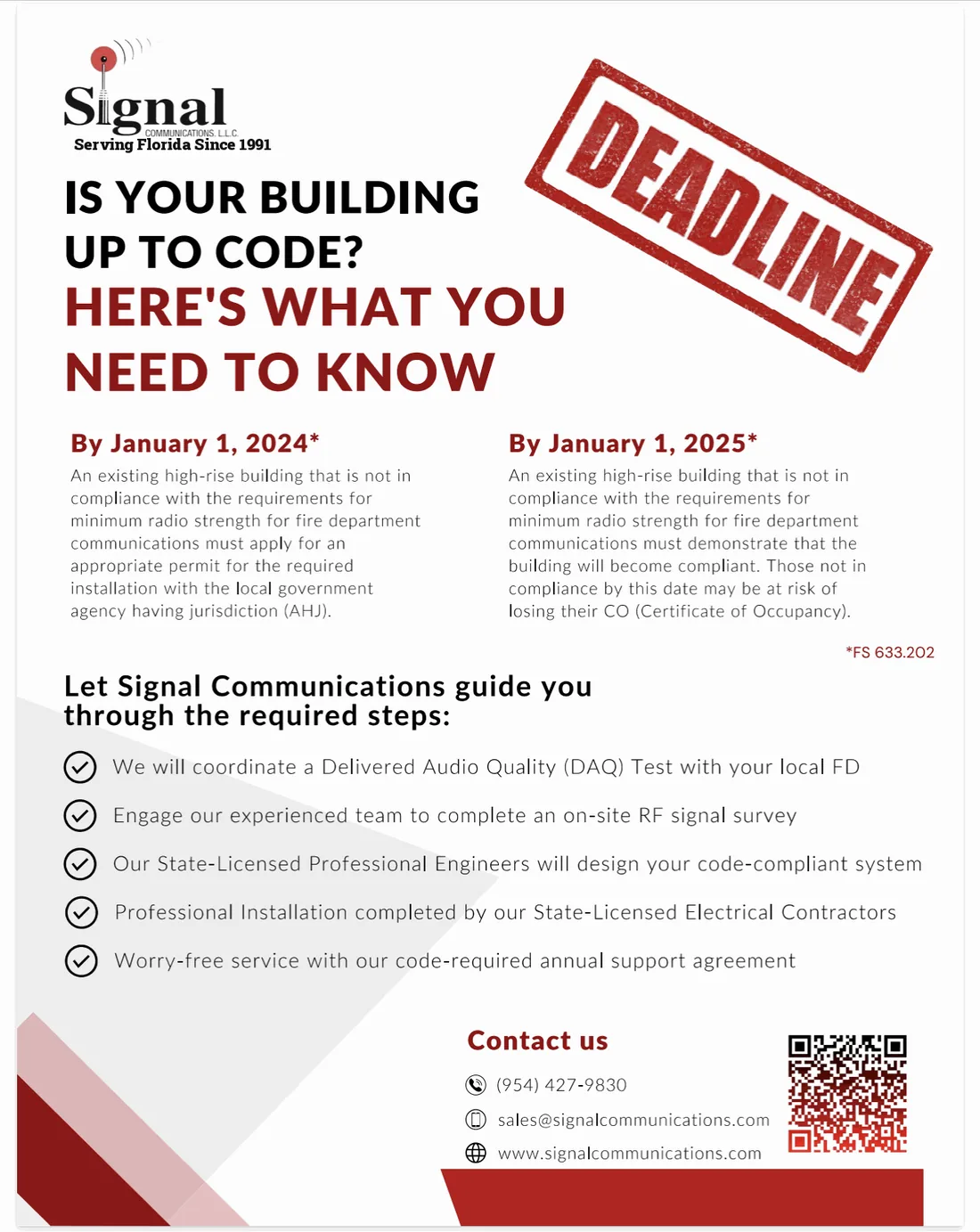

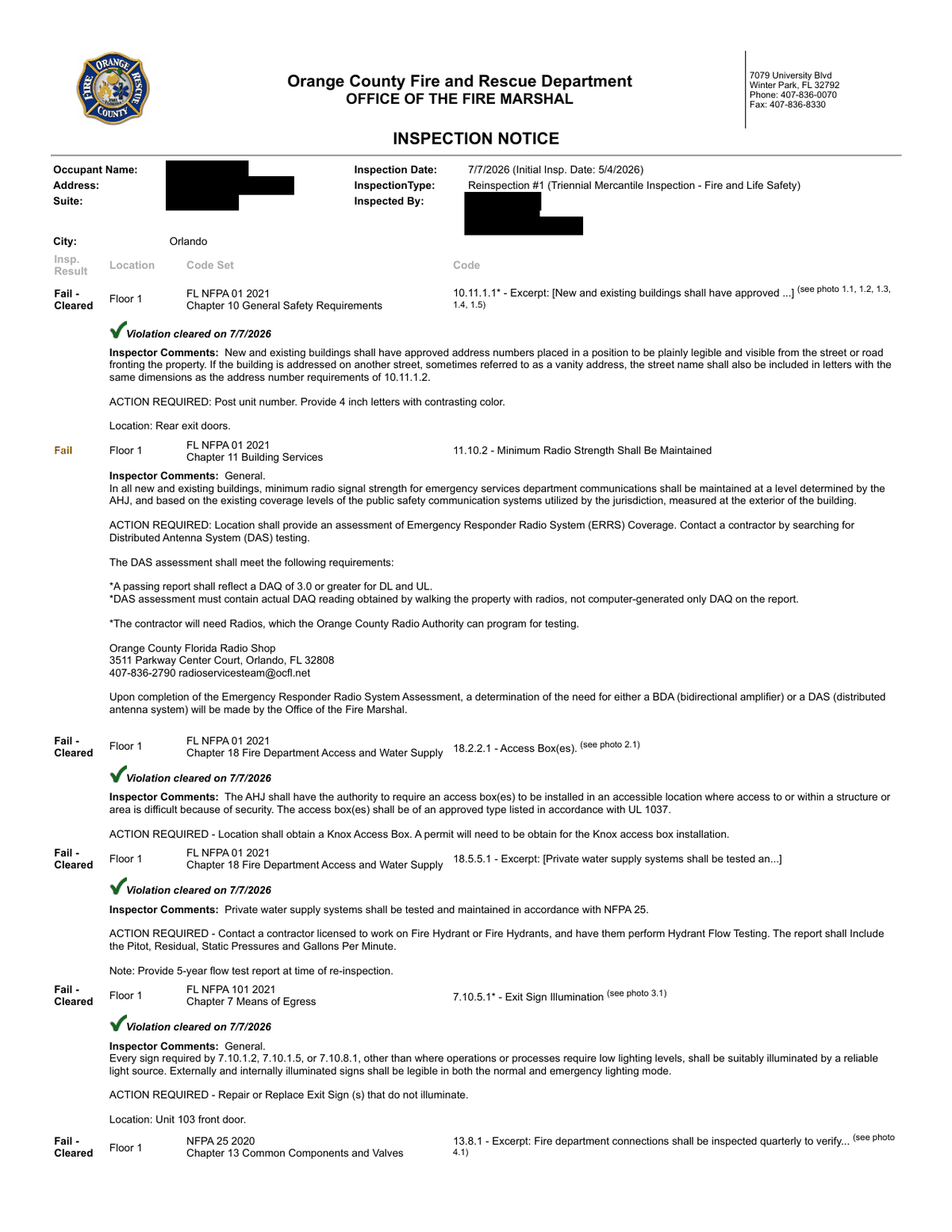
The notice rarely uses the words you expect. It might say BDA. It might say public safety signal, emergency responder radio communication system, ERRCS, or simply whatever the inspector wrote in the field that day. However it is phrased, it means the same thing: your building’s emergency responder radio system either failed, was never adequate, or cannot be shown to be compliant, and the clock is now running. This guide explains what you are looking at and what happens next.
What the notice actually means
Florida’s fire Code treats emergency responder radio coverage as a life safety system, in the same family as your fire alarm. When a fire inspector, a testing event, or an actual emergency reveals that first responder radios do not work adequately inside your building, the Authority Having Jurisdiction (AHJ) issues a notice requiring the condition to be corrected. The wording varies by County and by inspector. The obligation does not.
How buildings end up here
In our service work, out-of-compliance situations almost always trace to one of these:
- The system was flagged at an annual fire inspection, either because coverage failed or because required recertification paperwork was not on file.
- An alarm is sounding. BDAs are monitored by the existing building fire alarm system and report faults at the fire alarm panel they connect to.
- The system quietly died and nobody noticed. We have serviced systems that had been offline for years because a surge blew a fuse and the system was installed before interface to the fire alarm panel was required. The failure surfaces at the worst possible moment.
- Somebody broke it. Contractors working in buildings cut cables, break antennas, and unplug equipment more often than anyone would guess.
- The environment changed. A new building next door, a renovation, or changes to the public safety network itself can degrade a system that was perfectly compliant when installed.
- Age and neglect. Batteries and components have service lives. Without maintenance, they reach the end of them.
- There was never a system at all, and enforcement has caught up with the building.
What happens if you ignore it
The notice comes with a compliance deadline, and the consequences of missing it escalate: reinspection failures, fines, and in serious cases questions about the building’s occupancy status. More importantly, the underlying condition is real. A building where first responder radios do not work is a building where an emergency is more dangerous for everyone inside, and where the owner’s exposure if something happens is difficult to overstate. The one thing a violation notice should never receive is a place at the bottom of a pile.
The first 48 hours with Signal
When a building calls with a failed, flagged, or alarming BDA, here is Signal's proven process:
Dispatch. We maintain local technicians across our Florida service area and can typically be on site within 24 to 48 hours on weekdays. Emergency after-hours and holiday response is also available.
Full investigation, not just the alarm. Alarms tell you something is wrong, not always what is specifically broken. On a recent after-hours call, an out-of-state owner of a South Florida retail property had a BDA alarm indicating an antenna fault. The actual problem was power. Our technicians read the alarms, connect a laptop to the system’s back end, and physically inspect the equipment, because the diagnosis has to be earned, not assumed.
A written path forward. Based on the investigation, you receive a proposal to address what was found: a repair, a recertification, or in the hardest cases a replacement plan. Every situation is handled case by case, because the right answer depends entirely on the system’s condition and the signal environment around it.
Repair, recertify, or replace
Repair covers the mechanical or electrical component failures: power, circuit boards, batteries, damaged cabling and antennas, blown surge or lightning protection. Recertification is the annual requirement in most Florida jurisdictions: an updated coverage scan and documentation filed to show the system still performs. Many flagged buildings are mechanically fine and simply out of certification. Replacement enters the picture for systems so old, defunct, or unmaintained that the authority orders them decommissioned and replaced. That decision belongs to the AHJ, and when it happens, the project follows the full process in our Florida Public Safety BDA Guide.
Staying off the violation list
Most Florida jurisdictions require an annual service agreement and annual inspection for these systems, and some, including the Miami area, will not issue final sign-off on a new system until a support contract is in place. That is not bureaucracy. It is the Code recognizing what our service files confirm: monitored, maintained systems do not show up on violation lists, and unmonitored ones eventually do. If your system is not currently under a service agreement, that is the single most effective thing to change.
Frequently Asked Questions
The notice states its own deadline, and deadlines vary by jurisdiction. What is universal: response time is the one part of the situation you fully control, and authorities notice and generally accommodate the owner who engages immediately over an owner who does not.
Yes. ERRS, ERRCS, emergency responder radio coverage, public safety signal, and BDA all refer to the same requirement. Different Counties and inspectors use different terms.
Yes. An alarming BDA is reporting a fault, and some faults degrade the system in ways that only surface during an emergency or a test. Diagnosis generally requires an on-site investigation.
The AHJ has that power for systems that can no longer be brought into reliable compliance. It is the outcome good maintenance exists to prevent, although sometimes technology changes to the public safety communication system by the AHJ require replacement.