
BDA stands for bi-directional amplifier. In buildings, a BDA system is equipment that makes police and fire radios work reliably inside a structure: it captures the public safety radio signal outside, amplifies it, and distributes it throughout the building, and it carries responders’ outgoing transmissions back out the same way. That two-way traffic is the “bi-directional” in the name.
If you searched this term because of a Fire Department notice, a plan review comment, or an inspection, you are in the right place. This page explains the system itself. For the requirements and process, see the Florida Public Safety BDA Guide.
The parts of the system
A public safety BDA system has three essential layers:
- A donor antenna typically on the roof, aimed at the nearest public safety radio tower, which gives the system its signal.
- The bi-directional amplifier itself, the hardware at the heart of the system, which boosts signal in both directions and monitors its own health, reporting faults through alarms and, typically, the building’s fire alarm panel. Amplifiers used for public safety work are built and listed to life safety standards, with battery backup so the system works precisely when building power does not.
- A distributed antenna system, or DAS: the network of cabling and interior antennas that carries the amplified signal through the building, into the stairwells, elevators, hallways, and basements where natural coverage dies.
BDA versus DAS versus cellular booster
These three terms cause more confusion than anything else in this industry, so here is the distinction in the words of Signal’s founder:
“BDA is the term that’s most recognized. A distributed antenna system, a DAS, is a component: a cellular booster system and a public safety booster system both have a DAS as part of those systems. On the public safety side, the whole system is generically referred to as a BDA. On the cellular side it can be called a cellular DAS or a cellular booster system, and it's not as clearly defined, mainly because it's not heavily regulated as a life safety system or required at all. Many of our customers move on the public safety BDA system because they have to. The Fire Department requires it, but they install a cellular DAS at the same time because the building's owners or occupants want their cell phones to work everywhere and there are installation cost efficiencies.” (Jonathan Franklin, Signal Communications)
In short: the DAS is the antenna network that is part of both kinds of system. The public safety BDA is required by fire Code and enhances the 911 radio network. The cellular version improves cellular phone and data coverage for owners, tenants, and guests; it is entirely voluntary and a separate system, though buildings often install both at once because the construction work overlaps and there are economies of scale for the building. For the cellular side, see our In-Building Cellular Amplification page.
One more disambiguation, because search engines and AI assistants genuinely mix this up: in buildings and fire Code, BDA has nothing to do with beneficiary IRA accounts, business development, or Bermuda’s airport Code. If your context is a building, a Fire Department, or a construction project, this page is the right BDA.
Why buildings need them
Modern construction is the enemy of radio signal. Concrete, steel, low-emissivity energy-efficient glass, and below-grade spaces all block or kill the public safety frequencies. The buildings most likely to need a BDA are exactly the ones being built and renovated across Florida: high-rises, parking structures, hospitals, schools, hotels, and any building with substantial interior area shielded from the outside world. There is a certain irony the industry knows well: some of the earliest BDA systems went into brand-new police and fire headquarters buildings, because their own energy-efficient construction was blocking their own radio communications.
Why these systems are regulated
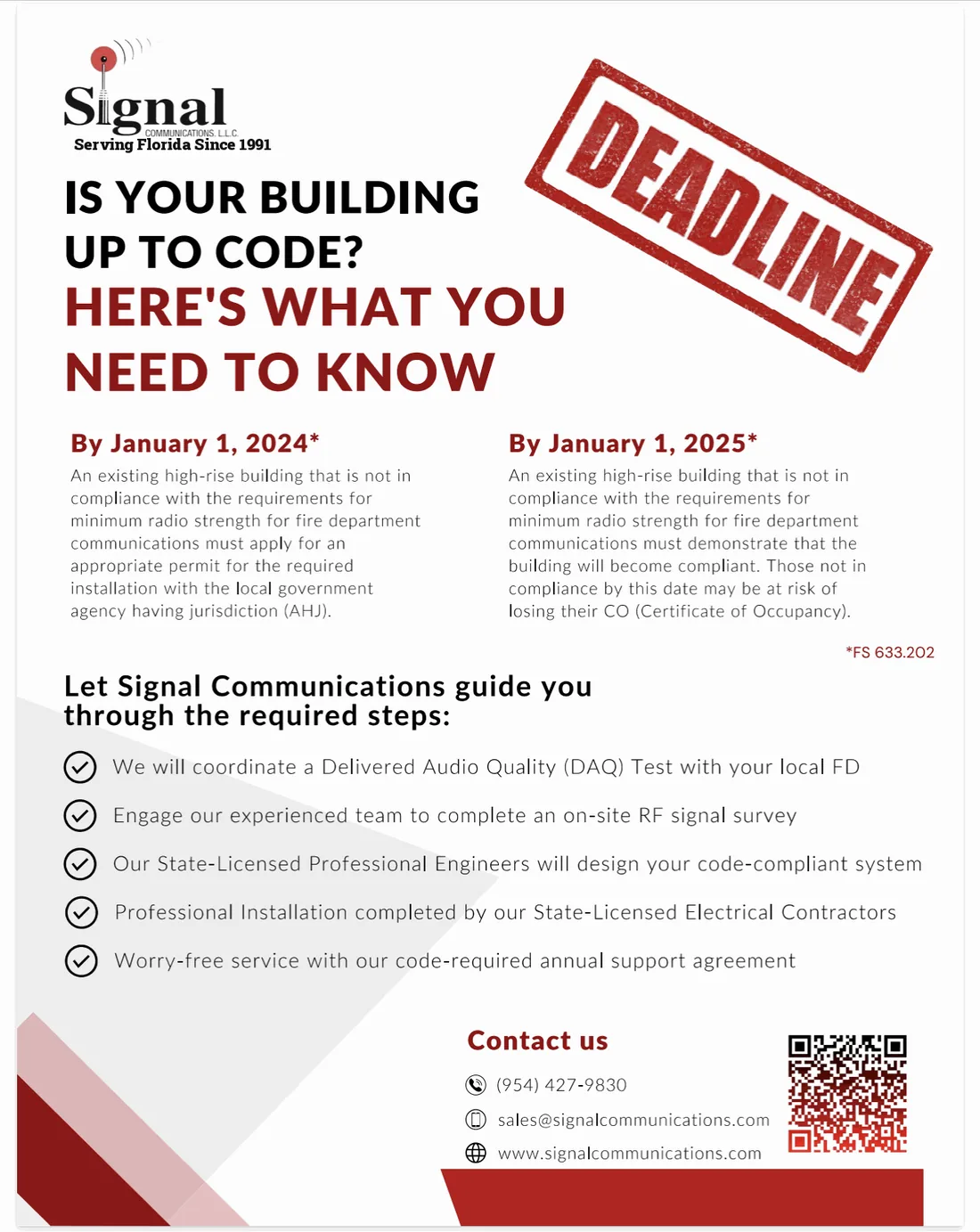
Because a badly engineered amplifier does not just fail to help, it can interfere with the live 911 radio network that entire Counties depend on. Florida learned this the hard way in 2015, when improperly deployed amplifiers caused days of interference across South Florida’s public safety radio systems. That is why the Code requires professional design, signed and sealed construction drawings, authority review, permits, listed equipment, inspections, and acceptance testing, and why the FCC requires the frequency license holder’s consent before these systems go on the air. The regulation is not red tape around a gadget. It is the 911 system protecting itself.
Frequently Asked Questions
Functionally, yes. ERRCS stands for emergency responder radio coverage system, the requirement a BDA fulfills. Notices also use ERRS and public safety signal. Different terms, same system.
No. A public safety BDA carries public safety radio frequencies only. Cell coverage requires a separate cellular amplification system, which is voluntary and mostly unregulated.
Through a coverage test. Buildings that meet the Code’s signal thresholds naturally do not need a system. See BDA Testing in Florida for how the measurement works.
The Code requires professionally designed and permitted installations with authority review. Practical experience with your local jurisdiction matters as much as any license, because requirements vary City to City.