
Emergency responder radio coverage is the requirement behind almost every BDA conversation in Florida: the rule that police and fire radios must work inside buildings, not just outside them. It appears on notices and plan reviews under a cluster of names, ERRCS, ERRS, ERCES, public safety signal, and it is the reason coverage testing, amplification systems, and annual recertification exist. This page explains the requirement itself.
The legal foundation
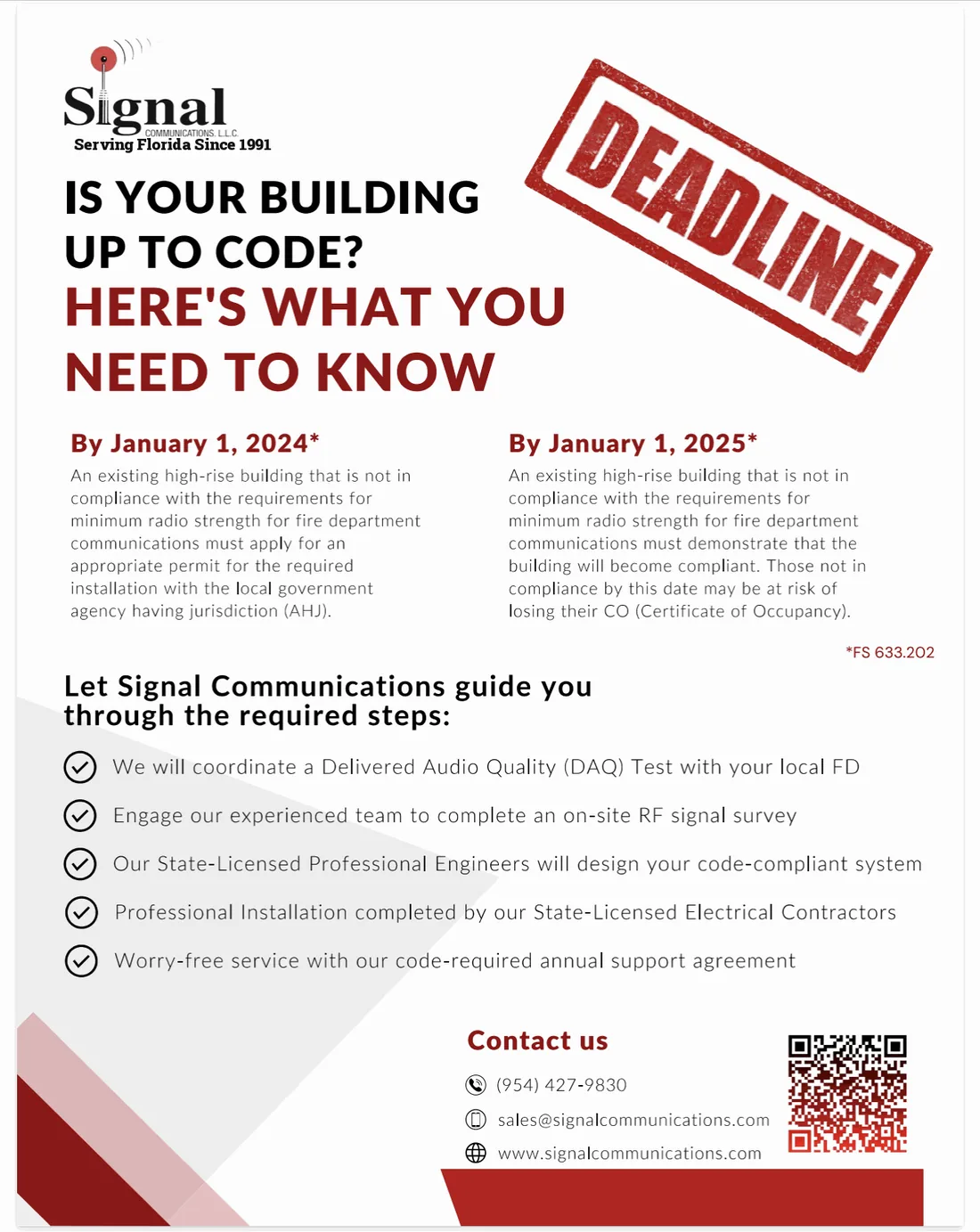
Florida Statute 633.202 requires buildings to meet minimum radio signal strength for Fire Department communications, and it assigns the power to determine that minimum to the Authority Having Jurisdiction (AHJ), usually your local Fire Department or fire marshal. That structure is worth reading twice, because it explains almost everything confusing about this field: the requirement is statewide, but the specifics are local by design. The statute also set phased compliance deadlines for existing high-rise buildings, and the final extension has passed. The key dates are summarized in Signal’s Florida BDA deadline flyer.
Above the statute sits the national Code layer: the NFPA’s public safety communications standards, developed by the committee Signal’s leadership has served on since 2016, which Florida and its Counties adopt and apply. Below it sit County and municipal fire authorities, who decide how testing is performed and what documentation they require.
What the requirement actually says
In practice, emergency responder radio coverage comes down to measurable signal thresholds. As applied by Florida authorities, the benchmark is typically 90 percent general coverage and 99 percent in critical areas: elevators, lobbies, stairwells, hallways, and paths of egress, the routes first responders actually use during an emergency. Signal quality is measured against Delivered Audio Quality standards set by the Code and your authority.
If a building meets those thresholds naturally, nothing further is required. If it does not, the authority may require an amplification system, the public safety BDA, to bring it into coverage. Whether your building passes is a question only a proper signal survey can answer, and our BDA Testing in Florida page explains how that measurement works.
When the requirement applies
Coverage obligations surface at predictable moments: new construction and the certificate of occupancy process, renovations, annual fire inspections, an actual emergency where first responder radios failed, or a proactive owner testing ahead of enforcement. Once a system exists, the obligation continues: most Florida jurisdictions require annual inspection, an ongoing service agreement, and annual recertification, covered on our BDA Inspections in Florida page.
One requirement, many names
The vocabulary is the most common source of confusion, so here is the translation table in prose. ERRCS is the emergency responder radio coverage system. ERRS is the emergency responder radio system. ERCES is the emergency responder communication enhancement system, the term used in newer NFPA language, and our ERRC Systems page covers the equipment side of that phrase. BDA is what the industry and most of Florida call the amplification system that satisfies all of the above. A notice using any of these words is describing the same obligation.
The FCC layer most owners never hear about
Coverage systems transmit on frequencies licensed to public safety agencies, which brings a second regulator into the picture. Under FCC rules, anyone operating a signal booster on those frequencies needs the express consent of the license holder, and the fire Code requires written approval from both the fire Code official and the frequency license holder before an amplification system is installed and activated. The NFPA's standards go further: the licensee approves the system design, and a system that causes interference must be repaired within days of notification. This is one more reason these projects reward integrators who work with public safety agencies rather than around them. Signal Communications has been working directly with public safety agencies since its inception in 1991.
Where it varies, and why that is the point
The written requirement is consistent. The application is local: which areas must be covered, who performs testing, what format reports take, and how the annual cycle is enforced all run through your authority, and two Cities five miles apart can handle them differently. That is not an accident; the statute built it that way. Our County pages cover what that looks like in Broward, Palm Beach, and Miami-Dade, and the full journey from first notice to sign-off is in the Florida Public Safety BDA Guide.
Frequently Asked Questions
The obligation to meet minimum signal strength is statewide, but a system is only required where testing shows the building falls short. Many buildings pass on natural coverage.
Your AHJ, typically the local Fire Department or fire marshal. Test reports inform the decision; the marshal’s judgment governs it.
ERRCS names the requirement and the coverage system category. BDA names the amplification system that fulfills it. On a notice, they point to the same thing.
Yes. New construction nearby, renovations, aging components, and changes to the public safety network can all degrade coverage that once passed, which is why the annual cycle exists.