
Testing is where Florida’s public safety radio requirements become real. It is how a building first learns it needs a BDA, how a finished system earns its sign-off, and how an existing system proves, year after year, that it still protects the people inside. Some enforcement notices even tell owners exactly what to search for when they receive a notice or Code violation: distributed antenna system testing, DAS testing, or a BDA scan. Whatever your notice calls it, this page explains what the test involves.
What the test measures
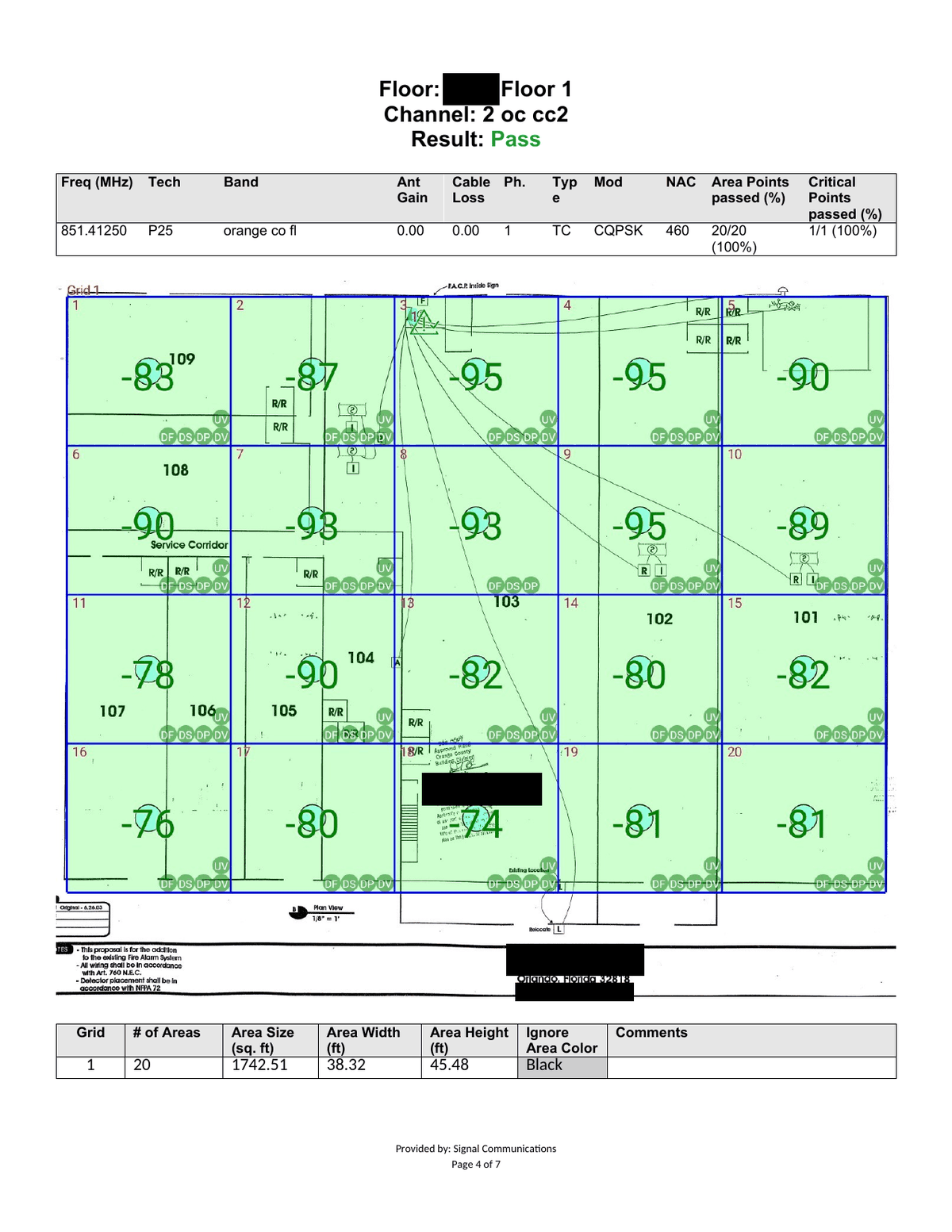
A coverage test is a structured signal survey. A grid is overlaid on the building's floor plans, typically 20 roughly equal areas per floor or 20' x 20' squares depending on your AHJ's requirements, and the public safety radio signal is measured in each grid square. Results are evaluated against the coverage thresholds in the applicable Code as applied by your local authority, typically 90 percent required coverage in general areas and 99 percent in critical areas, with signal quality measured against Delivered Audio Quality (DAQ) standards set by the Code and your authority. How specific does this get? A recent Orange County, FL notice spells it out: a walked Delivered Audio Quality of 3.0 or greater on both downlink and uplink, measured with county-programmed radios, with computer-generated-only readings rejected. Your jurisdiction sets its own version of exactly this kind of detail.
Authorities care most about critical areas: elevators, lobbies, stairwells, hallways, and paths of egress, the routes first responders actually move through during an emergency. Interior units and hotel rooms typically matter less than the public circulation spaces around them.
Who performs the testing
In most Florida jurisdictions, the Fire Department performs or participates in coverage testing. A few Counties instead require the systems integrator to perform the testing on the department’s behalf, using specified equipment, properly calibrated, with results reported in a prescribed format. Submitting the wrong format or using uncalibrated equipment means doing it again, which is one of several reasons jurisdiction experience matters when choosing who tests your building.
Pass, fail, and who decides
The cover page of a test report reads pass or fail. Behind that simple answer sits an important reality: the fire marshal’s judgment governs. An authority can accept a report’s findings or override them in either direction, and we have seen both. A report can say fail and the authority can pass the building; a report can say pass and a marshal whose radios failed during a DAQ test or a real response can rule it a fail. Their call stands. Testing is a measurement; compliance is a decision, and the decision belongs to your local authority.
When testing happens
- The first test, triggered by an inspection, a notice, an emergency, or a proactive owner, determines whether a building needs a system at all. Signal Communications can typically schedule this initial scan within ten working days.
- Acceptance testing proves a newly installed system meets the coverage requirement before final sign-off.
- Annual recertification. Most Florida jurisdictions require an updated scan and filed documentation every year, alongside the annual service agreement the Code requires for these systems. Enforcement intensity varies by area; the written requirement does not. The trend around different regions of Florida and the country is more and more enforcement, some with steep fines.
If the building fails
A failed first test starts the design and installation process covered step by step in our Florida Public Safety BDA Guide. A failed test on an existing system starts the diagnosis and repair path covered in our What Happens Next section. Either way, the test result is the beginning of a defined process, not a dead end. And the timeline can move: one recent Orange County, FL retail building went from a fire marshal notice citing minimum radio signal strength to a passing coverage report in seventeen days.
Frequently Asked Questions
We can typically have a technician on site within ten working days, and faster when our crews are already working in your area.
Yes. BDA scan, DAS testing, coverage survey, and public safety signal testing all describe the same measurement. Enforcement notices in different Counties use different terms.
Usually yes. Scan data is routinely shared so multiple firms can design and bid from one survey.
Florida Statute 633.202(18)(c)2 says the AHJ may require an assessment of the building's interior public safety radio coverage: not more than once every 3 years for an existing high-rise building or an existing building over 12,000 total gross square feet, and once every 5 years for other existing buildings. There are exceptions that allow the assessment to be required sooner, including a Level III building alteration or rehabilitation, reconstruction, a public safety agency reporting that its radios failed to function correctly inside the building, or the building being determined an imminent life safety threat to first responders. Existing BDA systems generally need annual testing and recertification.