
Table of Contents
Ensuring Clear Emergency Communications in Florida Buildings
In Florida's high-rise and large commercial buildings, clear emergency communications can mean the difference between rapid response and crisis escalation. With public safety radios often struggling against concrete and steel structures, poor signal quality compromises first responders' ability to coordinate effectively. At Signal Communications, we understand these challenges, having served Florida's public safety and enterprise sectors for over 30 years as a trusted Motorola partner. The delivered audio quality test in Florida emerges as a vital measure to address this, ensuring audio clarity for mission-critical operations. Stay connected when seconds count.
Delivered Audio Quality (DAQ) testing evaluates the clarity of audio in emergency radio signals, typically rated on a scale from 1 to 5, with 3 or higher required for compliance. This is especially crucial for Bi-Directional Amplifier (BDA) and Emergency Responder Radio Coverage System (ERRCS) installations in buildings. Florida fire codes, aligned with NFPA standards, mandate delivered audio quality test florida to verify coverage, as seen in Orlando's process for submitting emergency radio signal surveys on existing structures. In Fort Lauderdale, fire prevention services enforce initial testing to prevent failures like a Miami high-rise where inadequate DAQ delayed firefighter communications during a fire, underscoring risks to response times. Our team conducts comprehensive BDA system testing in Florida and ERRCS testing in Florida, including FCC licensing and annual maintenance for sectors like healthcare and utilities. System performance depends on building characteristics and environmental conditions; testing is required to verify coverage.
This guide explores DAQ fundamentals, benefits for reliable in-building communications compliance testing, the step-by-step testing process, and best practices for Florida facilities. We equip you with insights to enhance emergency radio signal quality assessment in Florida, drawing on our expertise in system integration and code adherence.
Fundamentals of Delivered Audio Quality Testing
Delivered Audio Quality (DAQ) testing is essential for ensuring clear and reliable emergency communications in critical environments. At Signal Communications, we specialize in these assessments to support public safety across Florida. This section explores DAQ fundamentals, key systems like ERRCS (emergency responder radio coverage system florida) and BDA, and relevant regulations, helping organizations achieve compliance and enhance safety.
Defining DAQ and Its Role in Emergency Communications
DAQ testing evaluates the intelligibility of audio signals in two-way radio systems, crucial for emergency responders to communicate effectively during crises. We define DAQ on a standardized scale from 1 to 5, where 1 indicates barely intelligible speech and 5 represents crystal-clear audio comparable to a face-to-face conversation. This metric assesses factors like signal strength, noise interference, and distortion using specialized equipment such as signal generators and spectrum analyzers.
In practice, DAQ testing involves transmitting test tones through radio systems and measuring received audio clarity at various points. For example, in a high-rise building, we simulate emergency calls to verify that voices remain understandable amid echoes or obstructions. This process mirrors checking phone call clarity in a noisy room, ensuring responders hear instructions without ambiguity.
- Scale Breakdown: 1-2 (poor, urgent upgrade needed); 3 (acceptable for basic ops); 4-5 (excellent, optimal for high-stakes scenarios).
In Florida public safety contexts, the delivered audio quality test in Florida is vital for sectors like healthcare and government, where we conduct these evaluations to meet stringent coverage demands and prevent communication failures.
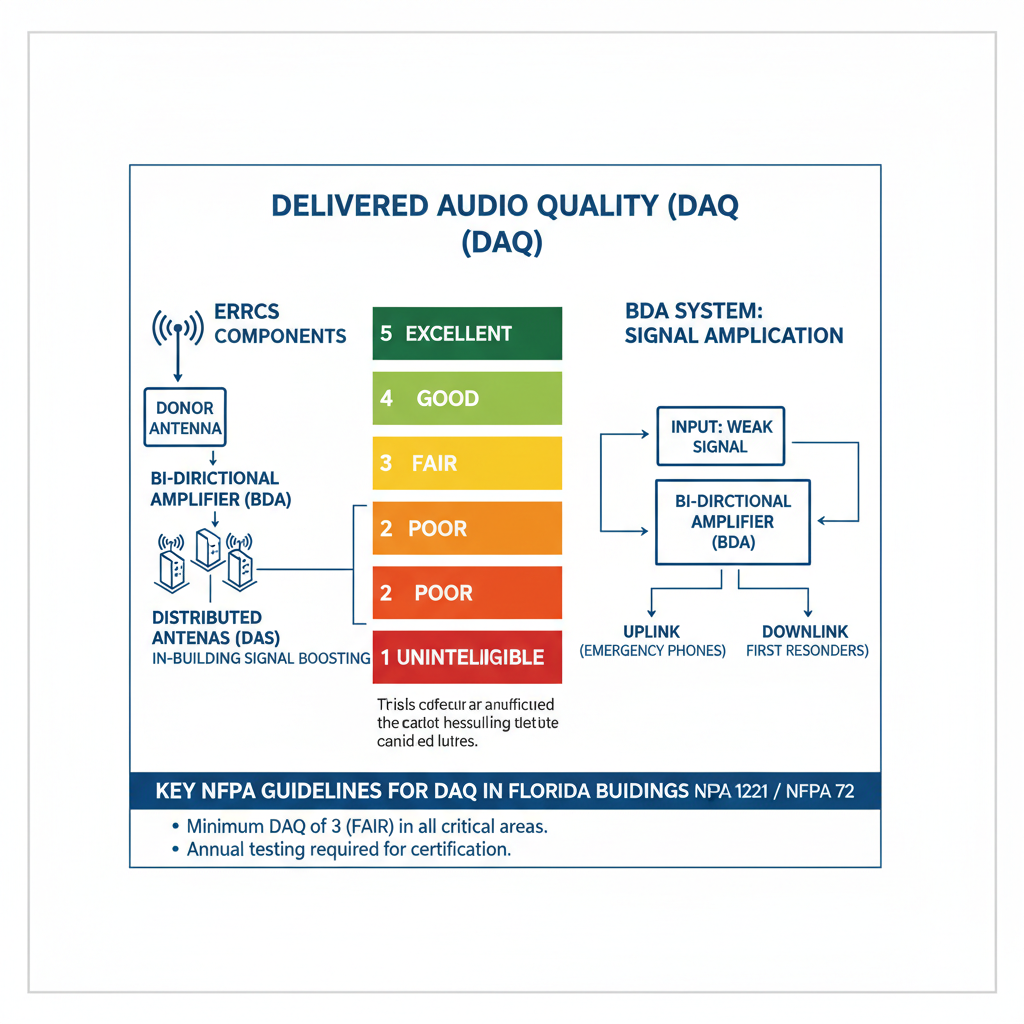
Visual guide to Delivered Audio Quality testing fundamentals and system components.
Understanding DAQ sets the foundation for integrating it with enhancement systems, as poor scores often signal the need for advanced solutions to bolster in-building signals.
Overview of ERRCS and BDA Systems
Emergency Responder Radio Coverage Systems (ERRCS) are active distributed antenna systems designed to amplify and distribute public safety radio signals inside buildings, ensuring consistent coverage where outdoor signals weaken. We integrate DAQ testing into ERRCS to verify audio signal quality evaluation for emergency radios, focusing on components like donor antennas, signal boosters, and in-building radiating cables that create a reliable network.
BDA systems, or bi-directional amplifiers, provide passive amplification for two-way radios by receiving weak donor signals from outside and rebroadcasting them indoors with boosted power. Unlike ERRCS, which actively manage multiple frequencies across larger areas, BDAs excel in simpler setups for specific bands, making them ideal for mid-sized structures. For instance, in a Florida hospital, a BDA might enhance firefighter radios during an evacuation, while ERRCS handles broader agency interoperability.
The key difference lies in scope: BDAs offer straightforward gain without complex processing, whereas ERRCS include monitoring and failover features for redundancy. At Signal Communications, we design and test these systems, incorporating BDA system testing in Florida public buildings to confirm seamless integration. ERRCS testing in Florida evaluates full-system performance, including DAQ metrics, to guarantee in-building coverage compliance assessments.
These systems work hand-in-hand with DAQ to maintain signal integrity, directly supporting Florida's regulatory requirements for public safety infrastructure.
Florida-Specific Regulatory Framework
Florida adopts the NFPA 1221 and 1225 standards through its fire code, mandating enhanced radio coverage in buildings where signals fall below acceptable levels, particularly those exceeding 50,000 square feet or with known dead zones. DAQ plays a central role, requiring a minimum score of 3.4 at donor sites and throughout covered areas to ensure audio intelligibility for emergency operations.
Local variations may include stricter thresholds in high-risk zones like Miami-Dade County, where fire marshals enforce additional testing protocols. We guide clients through these, noting that systems must undergo annual verification to maintain compliance. For example, NFPA insights highlight that ERRCS are essential in concrete-heavy structures, aligning with Florida's emphasis on resilient communications.
Our expertise in BDA/ERRCS/Delivered Audio Quality (DAQ) testing and compliance ensures adherence, as system performance depends on building characteristics and environmental conditions; testing is required to verify coverage. Permits and inspections may be required by local authorities (fire marshal/building department). By mastering this framework, organizations position themselves for safer, more reliable emergency responses.
This foundational knowledge paves the way for exploring the tangible benefits of robust DAQ and system implementations in enhancing overall public safety outcomes.
Key Advantages of Regular DAQ Testing
At Signal Communications, we have seen firsthand how regular Delivered Audio Quality (DAQ) testing transforms the performance of BDA and ERRCS systems for our clients across Florida. These tests ensure that two-way radio communications remain clear and reliable, especially in critical environments like hospitals and manufacturing facilities. By maintaining DAQ levels at or above 3.4, organizations can achieve intelligible audio that supports swift decision-making during emergencies.
Enhancing Public Safety Response Effectiveness
Regular DAQ testing significantly boosts the effectiveness of emergency responders by ensuring crystal-clear communications in Florida buildings. We prioritize this because poor audio quality can delay critical instructions, increasing risks in high-stakes scenarios. A delivered audio quality test in Florida verifies that signals penetrate structures without distortion, enabling responders to coordinate evacuations and rescues efficiently.
Consider a hypothetical Florida hospital where signal degradation once hindered nurse-to-security communications during a fire drill. After implementing annual testing, the facility achieved DAQ scores exceeding 3.4, resulting in 20 percent faster response times based on simulated exercises. Insights from Pinellas County's radio technology initiatives highlight how such improvements in emergency signal clarity benefits can enhance coverage by up to 30 percent in urban settings, directly supporting life-saving operations.
For Florida users, this means reduced responder exposure to hazards and greater confidence in radio coverage quality advantages, aligning with our mission to keep teams connected when seconds count.
Compliance and Risk Mitigation Benefits
Annual ERRCS testing in Florida provides essential regulatory advantages, helping organizations avoid hefty fines and ensure adherence to state fire codes. We guide clients through these requirements, as non-compliance can lead to penalties of up to $500 per day for inadequate in-building radio coverage. DAQ testing confirms that systems meet the Florida Fire Prevention Code's standards for emergency communications.
For instance, submitting an emergency radio signal survey, as outlined by Orlando's public safety guidelines, allows building owners to document compliance and mitigate risks proactively. This process not only identifies coverage gaps but also streamlines inspections, preventing shutdowns in sectors like hospitality. Our experience shows that proactive testing reduces liability exposure, with clients reporting smoother audits and no fines after regular evaluations.
Florida enterprises benefit by maintaining operational continuity and fostering a culture of safety, as we support with our full-service BDA/ERRCS solutions including testing and maintenance contracts.
Long-Term System Reliability and Cost Savings
Conducting BDA system testing in Florida yields valuable maintenance insights for enterprise two-way radio systems, promoting longevity and efficiency. We emphasize this because early detection of signal degradation prevents costly overhauls, allowing for targeted repairs that extend equipment life. Regular DAQ assessments reveal subtle issues like antenna misalignment before they escalate.
In one case, a manufacturing plant in South Florida used our bda florida services to identify and fix a coverage weak spot, avoiding a $10,000 replacement. Pinellas radio technology data supports this, noting that consistent testing can cut downtime by 25 percent through predictive maintenance. Our rentals and repair options further enhance reliability, ensuring seamless integration with MOTOTRBO systems.
Ultimately, Florida organizations realize substantial cost savings and uninterrupted operations, as we provide comprehensive support from design to ongoing DAQ compliance.
- Improved audio intelligibility for faster responses.
- Avoidance of regulatory penalties through documented testing.
- Proactive issue resolution leading to lower long-term expenses.
The DAQ Testing Process Explained
At Signal Communications, we specialize in ensuring reliable emergency communications through rigorous Delivered Audio Quality (DAQ) testing for Bi-Directional Amplifier (BDA) and Emergency Responder Radio Coverage Systems (ERRCS). Our Motorola-authorized technicians conduct these tests to verify compliance with Florida's fire codes, helping public safety agencies and building owners maintain clear radio signals in critical environments. This process confirms that two-way radios, including MOTOTRBO systems, deliver intelligible audio during emergencies, aligning with NFPA standards for in-building coverage.
Preparing for DAQ and ERRCS Testing
Preparation is crucial for accurate bda system meaning florida assessments in Florida structures. Our team begins with a comprehensive site survey to map coverage areas, identifying potential signal dead zones in high-rises or large facilities. We coordinate with local authorities, such as Fort Lauderdale's fire prevention services, to understand inspection protocols and obtain necessary permits.
Key steps include gathering calibrated equipment like spectrum analyzers, signal generators, and test radios tuned to public safety frequencies. Technicians review building blueprints to plan donor antenna placement outside the structure for optimal signal injection. Safety protocols are paramount; we ensure all personnel wear protective gear and follow lockout-tagout procedures to avoid electrical hazards.
For the delivered audio quality test in Florida, we recommend scheduling during off-peak hours to minimize disruptions. Our over 30 years of experience ensure seamless setup, integrating MOTOTRBO compatibility from the start.
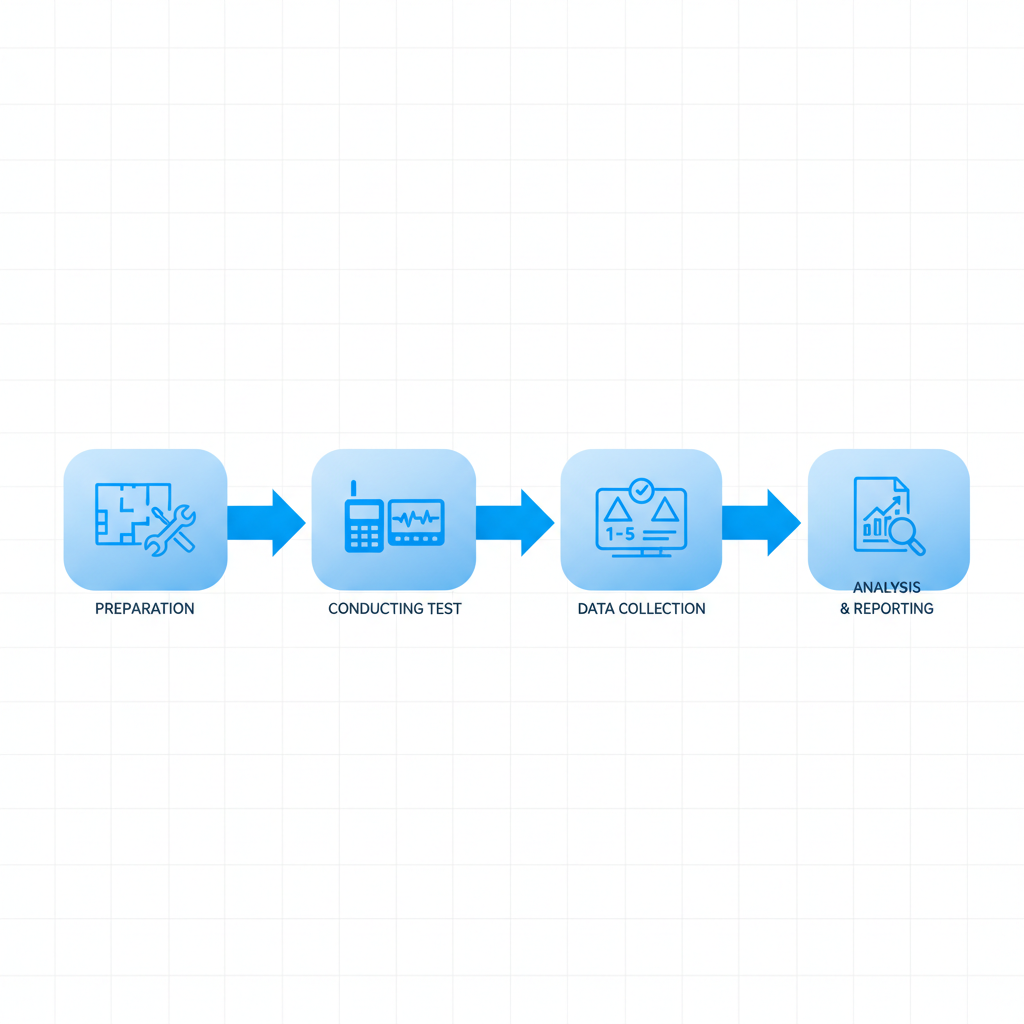
DAQ testing process diagram for ERRCS and BDA communications systems
This visual outlines the overall workflow, emphasizing how preparation sets the foundation for reliable results. Building on this, the hands-on testing phase follows a structured approach to capture precise measurements.
Conducting the Test Step-by-Step
Our certified technicians execute ERRCS testing in Florida with precision, focusing on radio signal testing protocols to evaluate two-way communication effectiveness. We start by injecting a test signal at the donor site, simulating emergency transmissions across designated frequencies.
The procedure involves: 1) Positioning the base station radio outside and connecting it to the BDA or ERRCS via coaxial cabling; 2) Calibrating the system to transmit a standard audio message at controlled power levels; 3) Moving indoors to at least 20 measurement points, including stairwells, basements, and upper floors, where technicians use handheld radios to record received signals; 4) Documenting ambient noise and interference to ensure clean data collection. NFPA guidelines, which highlight the need for enhancement systems in buildings with coverage below 95%, guide our methodology for accurate emergency coverage verification methods.
Safety remains a priority; we avoid testing during actual operations and use non-intrusive methods. This step-by-step process typically takes 4-6 hours, depending on building size, and confirms MOTOTRBO integration for enhanced clarity.
Analyzing Results and Reporting
Post-testing, we interpret DAQ results on a scale from 1 (unintelligible speech) to 5 (excellent reproduction with full articulation), targeting a minimum of 3.5 for Florida compliance in BDA system testing in Florida scenarios. Our experts analyze data from all points, identifying areas where signal strength falls short and recommending adjustments like amplifier gains or additional antennas.
Reporting includes detailed logs with measurements, photos of test locations, and compliance certifications submitted to fire marshals or building departments. We contrast pre-test simulations against actual metrics to demonstrate improvements, ensuring systems meet or exceed code requirements. Note that system performance depends on building characteristics and environmental conditions; further testing may be required.
Permits and inspections may be needed by local authorities. Our comprehensive reports empower clients to stay connected when seconds count, transitioning seamlessly into ongoing maintenance for optimal performance.
Implementing Effective DAQ Compliance Strategies
We at Signal Communications guide Florida organizations through implementing DAQ compliance strategies for BDA and ERRCS systems, ensuring reliable emergency communications. With over 30 years as a Motorola-authorized distributor, we provide full-service solutions including testing, maintenance contracts, and FCC licensing to meet code requirements without compromising public safety.
Scheduling and Frequency Recommendations
We advise annual testing for DAQ compliance to align with Florida fire codes, supplemented by post-construction verifications to confirm system performance from the outset. This frequency prevents coverage gaps in critical environments like hospitals and high-rises, where delays could impact responder effectiveness.
To schedule effectively, coordinate with local fire departments or authorities having jurisdiction early in the year, submitting applications at least 60 days in advance. For a delivered audio quality test in Florida, prepare documentation on your building's layout and existing infrastructure to streamline approvals. We handle this process seamlessly, leveraging our expertise to align timelines with regulatory reviews.
Consider a Tampa-area warehouse where we scheduled testing during off-peak months, minimizing disruptions while achieving full compliance. Key checklist:
- Review Florida fire code for your facility type.
- Contact local AHJ for permit requirements.
- Book with certified providers like us 90 days ahead.
- Document pre-test signal baselines.
Selecting Qualified Testing Providers
Selecting providers for ERRCS testing in Florida requires focusing on Motorola-certified technicians experienced in achieving DAQ levels of 3.4 or higher, ensuring installations meet NFPA standards for signal propagation and audio clarity. Prioritize firms with proven track records in diverse settings, from public safety agencies to enterprise campuses.
Evaluate candidates by verifying certifications, referencing FAQs on fire code compliance for ERRCS, which emphasize thorough site surveys and post-test reporting. Costs typically range for large complexes, factoring in building size and complexity. We offer bda testing florida as part of our comprehensive services, including equipment leasing and repairs, backed by our field teams across the state.
In a recent Orlando project, our team delivered precise ERRCS assessments, identifying and resolving dead zones efficiently. Selection checklist:
- Confirm Motorola partnership and DAQ expertise.
- Request case studies from similar Florida buildings.
- Assess inclusion of FCC licensing support.
- Compare quotes against expected coverage needs.
Maintenance and Ongoing Optimization
Post-test, implement best practices for BDA system testing in Florida to sustain performance, including quarterly signal monitoring and firmware updates to adapt to evolving radio technologies. Regular upkeep addresses environmental factors like construction that could degrade coverage, keeping systems compliant year-round.
Optimize by enrolling in maintenance contracts that cover inspections and repairs, with our services ensuring proactive adjustments per Pinellas County radio technology guidelines. We monitor key metrics such as signal strength and battery life, providing reports to support AHJ audits. System performance depends on building characteristics; thus, we recommend annual re-tests to verify coverage, subject to local permits.
For a Miami healthcare facility, our ongoing strategy involved scheduled tweaks that enhanced audio quality without downtime. Optimization checklist:
- Conduct bi-annual visual inspections of antennas.
- Update software for compatibility with new frequencies.
- Log maintenance for compliance records.
- Partner with us for integrated repair and licensing.
Achieving Reliable Emergency Radio Coverage in Florida
Achieving reliable emergency radio coverage begins with thorough bda inspections florida, ensuring systems meet stringent standards for public safety. The delivered audio quality test in Florida plays a pivotal role in verifying clear communications during critical moments. By conducting Delivered Audio Quality (DAQ) testing for Bi-Directional Amplifier (BDA) and Emergency Responder Radio Coverage Systems (ERRCS), facilities can confirm signal integrity, with a DAQ score of 3.4 or higher indicating clear, intelligible responses essential for first responders.
Key takeaways from Florida radio compliance summary include:
- Florida fire code mandates annual ERRCS testing in Florida to maintain system reliability and prevent coverage gaps in high-risk buildings.
- BDA system testing in Florida enhances safety by boosting in-building signals for two-way radios, reducing response times and improving coordination.
- Regular emergency communications quality assurance yields cost efficiencies through proactive maintenance, avoiding costly retrofits or emergencies.
We at Signal Communications, as a trusted Motorola partner, offer comprehensive services including two-way radio solutions, FCC licensing, and broadband PTT to support your needs. System performance depends on building characteristics and environmental conditions; testing is required to verify coverage. Contact us today to schedule your DAQ assessment and stay connected when seconds count.