
Table of Contents
Understanding BDA Systems in Florida
In Florida's hurricane-prone regions, ensuring reliable emergency communications can mean the difference between chaos and coordinated response. Large buildings with thick concrete walls or underground parking often block radio signals, leaving first responders disconnected when seconds count. At Signal Communications, we understand these challenges, having delivered mission-critical solutions for over 30 years. Understanding the BDA system meaning in Florida -- bda meaning florida -- is crucial for building owners aiming to meet public safety standards.
A Bi-Directional Amplifier (BDA) serves as a vital signal booster, amplifying two-way radio signals for first responders in areas with poor coverage, such as high-rises or commercial complexes. As per FCC Part 90 regulations on signal boosters, BDAs enhance in-building radio coverage to support emergency operations. In Florida, the bi-directional amplifier in Florida buildings addresses unique structural hurdles like reinforced concrete that weaken signals. Our team designs and installs these systems to integrate seamlessly with existing infrastructure, providing clear communication paths.
Florida's fire code mandates BDA system requirements in Florida for enhanced radio coverage during emergencies, with a 2025 compliance deadline approaching for certain structures. These in-building signal enhancement systems benefit public safety agencies, healthcare facilities, and hospitality venues by ensuring reliable connectivity. Like a megaphone for first responders, a BDA amplifies voices when they matter most. Signal Communications is the Wireless Industry Leader in tailoring these emergency radio amplification solutions to your needs.
Next, explore bi-directional amplifiers, distributed antenna systems, and signal boosters--key tools for compliance and safety. Stay connected when seconds count as we detail each one.
Bi-Directional Amplifier in Florida
In Florida, understanding the BDA system meaning in Florida revolves around essential tools like the bi-directional amplifier, which enhances in-building radio coverage for first responders. This device amplifies two-way signals bidirectionally, ensuring reliable emergency communications in structures where signals weaken. We at Signal Communications emphasize its role in meeting public safety demands across the state.
Key Features
Bi-directional amplifiers boost uplink and downlink signals for two-way radios, supporting critical operations. Key aspects include:
- Frequency compatibility with 700/800 MHz public safety bands, as outlined in FCC Part 90 signal booster regulations.
- Automatic gain control to prevent oscillation and maintain signal integrity.
- Integration with donor antennas placed on building exteriors to capture external signals.
- Uplink noise suppression for clear transmissions in noisy environments.
- Monitoring capabilities for real-time performance alerts.
- Scalable design for integration with distributed antenna systems (DAS).
These features make the bi directional amplifier florida vital for Florida's high-rises and commercial spaces, such as those in Miami.
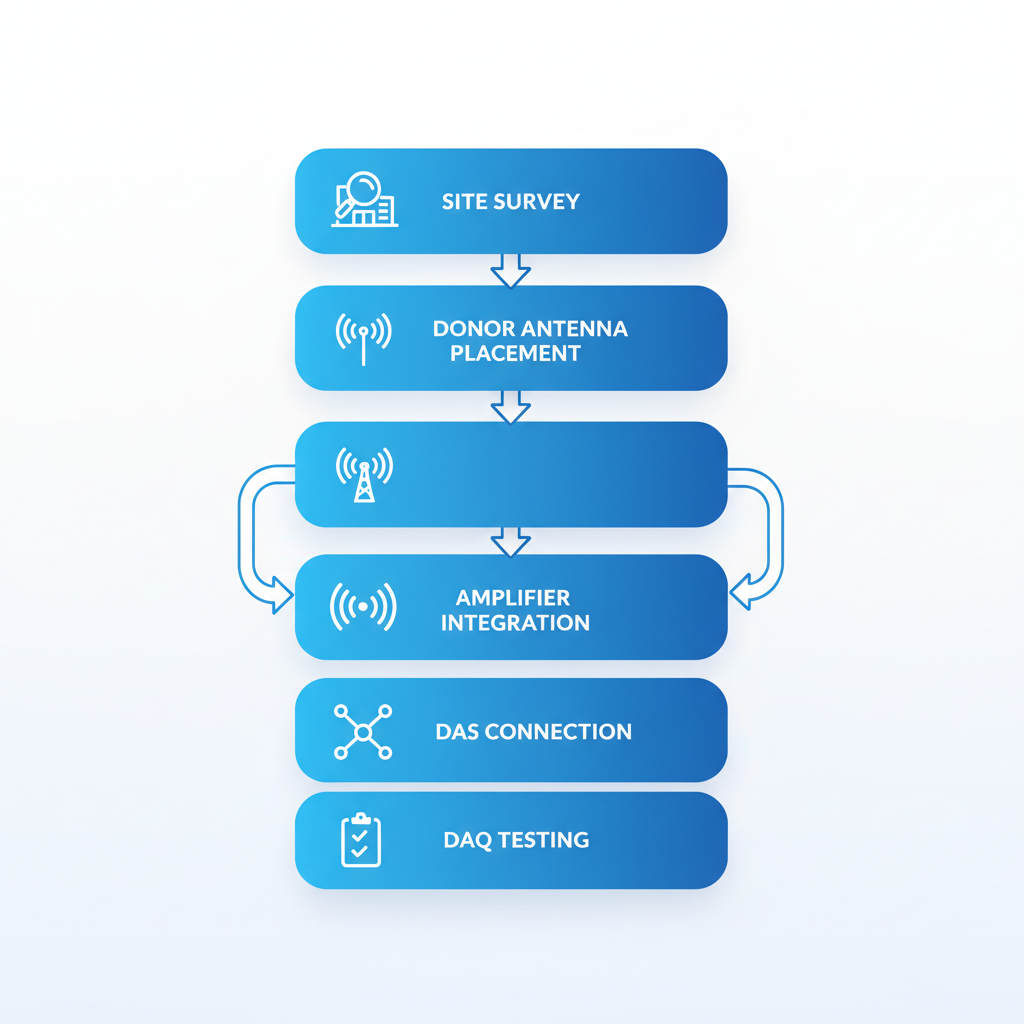
Five-step bi-directional amplifier installation process in Florida buildings
The installation process begins with a site survey to assess signal needs, followed by donor antenna placement, amplifier integration, DAS connection, and Delivered Audio Quality (DAQ) testing to verify coverage. System performance depends on building characteristics and environmental conditions; testing is required to ensure compliance.
Pricing for a bi-directional amplifier typically ranges depending on building size and complexity. Larger facilities in Florida often require more robust setups to achieve the necessary signal strength.
Pros
- Provides reliable signal boost for emergency responders, enhancing safety.
- Aids in achieving BDA system requirements in Florida, supporting code compliance.
- Scalable for various building types, including healthcare facilities.
- Integrates seamlessly with MOTOTRBO systems for advanced two-way communications.
Cons
- Involves complex setup, often needing professional installation.
- Requires ongoing maintenance to sustain performance.
- High initial costs compared to basic radio solutions.
Best suited for public safety buildings and hospitals in Florida that demand at least 95% in-building coverage for two-way radios. These emergency amplification devices ensure responders stay connected when seconds count. Permits and inspections may be required by local authorities, such as fire marshals. While bi-directional amplifiers provide core amplification, distributed systems offer broader coverage--explore next.
Distributed Antenna System in Florida
In large Florida facilities, a distributed antenna system in Florida serves as a vital complement to BDA setups, enhancing the BDA system meaning in Florida by ensuring uniform signal distribution for emergency communications. Our teams at Signal Communications specialize in designing these networks to meet stringent fire code requirements, providing reliable in-building coverage solutions for public safety.
See distributed antenna system florida for more information.
A distributed antenna system (DAS) functions as a network of remotely placed antennas that distribute amplified signals throughout indoor spaces, ideal for structures exceeding 50,000 square feet as mandated by Florida fire codes. Key features include multi-band support for various frequencies, remote monitoring capabilities for real-time diagnostics, and scalability to accommodate growing demands in high-occupancy buildings. Integration with a bi-directional amplifier in Florida allows for seamless amplification and even coverage, creating robust signal distribution networks. We offer comprehensive design, installation, and testing services to ensure compliance with BDA system requirements in Florida, including Delivered Audio Quality (DAQ) verification.
Pricing for DAS installations typically range depending on the facility's size and complexity. Signal Communications provides consultative assessments to align costs with specific needs, avoiding unexpected expenses through our full-service approach.
The pros of implementing a DAS include comprehensive, even coverage that future-proofs facilities against evolving communication standards, along with expandable designs that support additional users without major overhauls. However, cons involve high upfront complexity in engineering and installation, requiring expert oversight to navigate potential signal interference challenges. Our over 30 years of experience as a Motorola-authorized distributor ensures these systems are tailored for reliability, with maintenance contracts to sustain performance. System performance depends on building characteristics and environmental conditions; testing is required to verify coverage, and permits may be required by local authorities.
DAS solutions are best suited for large educational campuses and hospitality venues in Florida, where consistent connectivity across expansive areas is essential for safety and operations. Signal Communications is the Wireless Industry Leader in delivering these mission-critical systems, helping organizations stay connected when seconds count. For simpler setups, consider cell signal boosters next.
Commercial Cell Phone Signal Booster in Florida
At Signal Communications, we provide advanced commercial cell phone signal booster florida solutions designed to amplify cellular signals within buildings. These devices, often integrated with bi-directional amplifiers, enhance connectivity for emergency responders and daily operations. Understanding the BDA system meaning in Florida involves recognizing them as essential tools for ensuring reliable in-building communications during critical situations.
Key Features
Commercial cell phone signal boosters offer robust capabilities tailored for Florida's commercial settings. They support multiple carriers simultaneously, ensuring broad compatibility across networks like those used in public safety. With low PIM designs, these systems minimize interference for clearer signals. Power output typically ranges from 20 to 40 dBm, providing sufficient coverage for medium-sized facilities. As a bi-directional amplifier in Florida, they align seamlessly with BDA system requirements in Florida, including integration with Motorola equipment through our partnerships. These cell signal enhancers also feature remote monitoring for proactive maintenance, helping businesses stay compliant with state codes.
Pros and Cons
One major advantage is their cost-effectiveness compared to full DAS setups, with straightforward installation that minimizes downtime. They excel in enhancing emergency preparedness for retail and manufacturing sites in Florida. Maintenance is straightforward, though BDA systems must be tested annually or as required by local fire codes to verify performance. On the downside, these boosters are limited to specific frequency bands, potentially requiring additional units for comprehensive coverage. System performance depends on building characteristics, so professional testing ensures optimal results.
Best Applications
These solutions are ideal for transportation hubs and utilities in Florida, where reliable cellular access supports operations and safety. Retail spaces benefit from improved customer service through stronger signals. With over 30 years of experience as a Motorola partner, we deliver tailored installations that keep your team connected when seconds count.
Now, compare these tools side-by-side.
Comparing BDA Tools in Florida
When evaluating BDA system meaning in Florida, understanding the differences between bi-directional amplifiers, distributed antenna systems (DAS), and commercial cell signal boosters is essential for compliance with state fire codes. These amplification comparisons help building owners select the right Florida signal tools to ensure reliable emergency communications. We at Signal Communications guide clients through these options, focusing on features like coverage, cost, and installation to meet evolving requirements.
The following table outlines key attributes of these systems, drawing from FCC guidelines on signal boosters that must adhere to Part 90 standards for public safety bands:
FeatureBi-Directional AmplifierDistributed Antenna SystemCommercial Cell Signal Booster| Coverage Area | Targeted amplification in specific zones | Broad, multi-floor distribution | Focused enhancement for cellular signals |
| Scalability | Moderate, for medium buildings | High, expandable for large facilities | Limited, for small to medium areas |
| Installation Complexity | Medium | High, requires professional engineering | Low to medium |
| Florida Code Fit | Ideal for high-rises and critical areas | Suited for complex, multi-story buildings | Basic compliance for commercial spaces |
| Testing Frequency | Annual DAQ tests | Annual DAQ tests | As required, often annual for bda testing florida |
Bi-directional amplifiers in Florida excel in core signal amplification for targeted zones, making them a staple for meeting BDA system requirements in Florida, especially with 2025 mandates demanding enhanced in-building coverage for first responders. DAS systems shine in scalability for expansive structures, though at higher costs, while cell boosters offer affordable entry-level solutions. Per FCC standards, all must support public safety frequencies to avoid interference. System performance depends on building characteristics and environmental conditions; testing is required to verify coverage. We advise considering these factors alongside our full-service BDA/ERRCS installation and maintenance to ensure seamless compliance without absolute performance guarantees.
As Florida's building codes evolve, selecting the appropriate tool prevents costly retrofits and supports uninterrupted emergency response. Our expertise in system design and integration, backed by over 30 years as a Motorola partner, positions us to tailor solutions for public safety and enterprise needs. This strategic approach not only addresses current requirements but also future-proofs communications infrastructure.
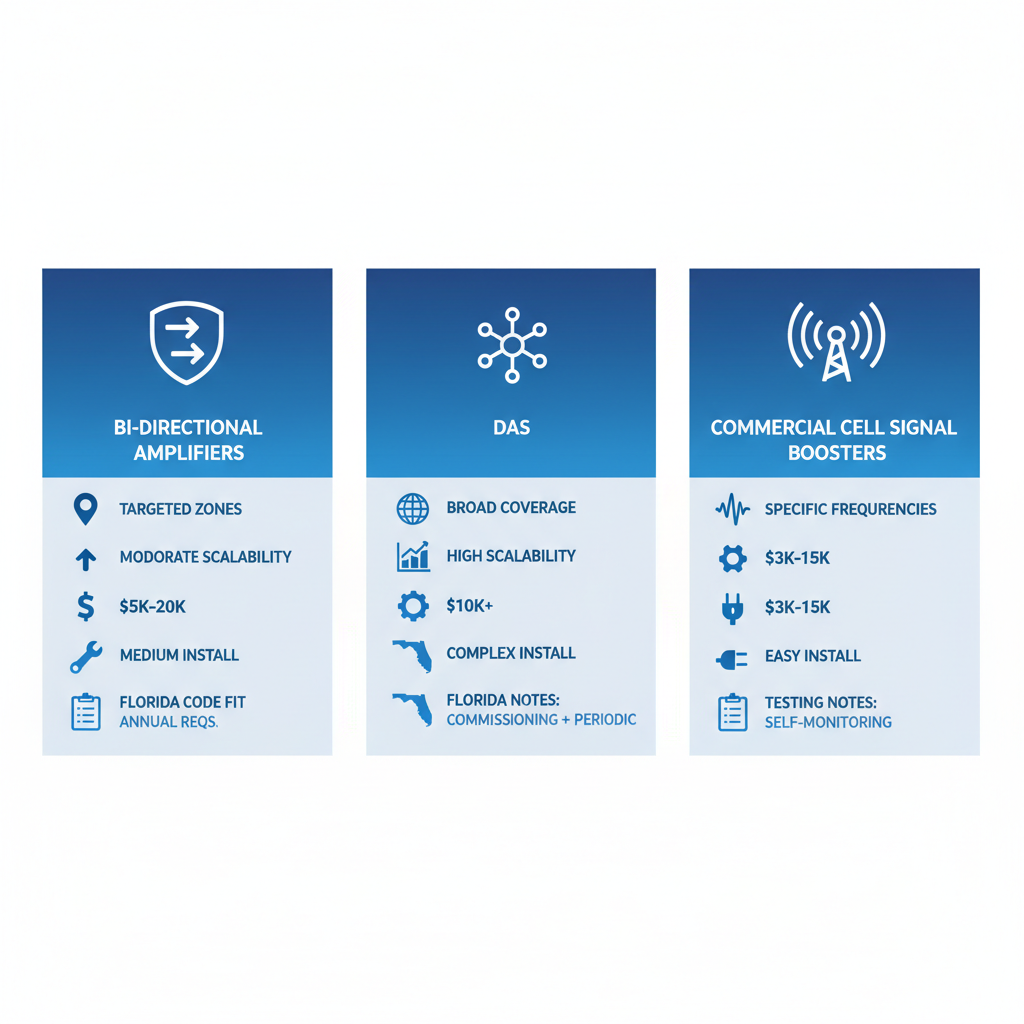
Comparison of BDA tools for Florida compliance featuring key metrics and FCC guidelines.
Ensuring BDA Compliance in Florida
Understanding the BDA system meaning in Florida involves recognizing it as a bi-directional amplifier designed to boost radio signals in buildings for reliable public safety communications. These Florida emergency systems ensure first responders maintain clear connections during crises, enhancing safety in high-rises, hospitals, and commercial spaces. As deadlines approach in 2025, compliance becomes essential for avoiding fines and operational disruptions.
Key takeaways include adhering to BDA system requirements in Florida, which mandate installation and regular testing for coverage in structures over 50,000 square feet or with underground parking. The bi-directional amplifier in Florida must meet NFPA and IFC standards to amplify signals effectively. We recommend conducting a self-assessment: Is your building compliant with Florida's BDA requirements? Evaluate signal strength and review local fire marshal guidelines to identify gaps. Signal compliance tools, like advanced testing protocols, verify performance without absolute guarantees, as system efficacy depends on building characteristics and environmental conditions.
At Signal Communications, with over 30 years as the Wireless Industry Leader, we provide expert sales, installation, and maintenance for BDA solutions. Stay connected when seconds count by partnering with us for comprehensive support, including delivered audio quality test florida to ensure code adherence. Contact us today to take your communications further and schedule a consultation--permits and inspections may be required by local authorities.